
Composition
The composition of laminated glass is expressed using a standard industry designation that identifies both the glass panes and the interlayer configuration. The first digits indicate the number and thickness of the glass panes, while the digit after the decimal point indicates the number of interlayers used. For example: 66.2 consists of two glass panes of 6 mm and two PVB interlayers. Although interlayers are available in different thicknesses (0.38, 0.76, 1.14, 1.52 mm and higher), the designation always refers to the number of 0.38 mm increments.
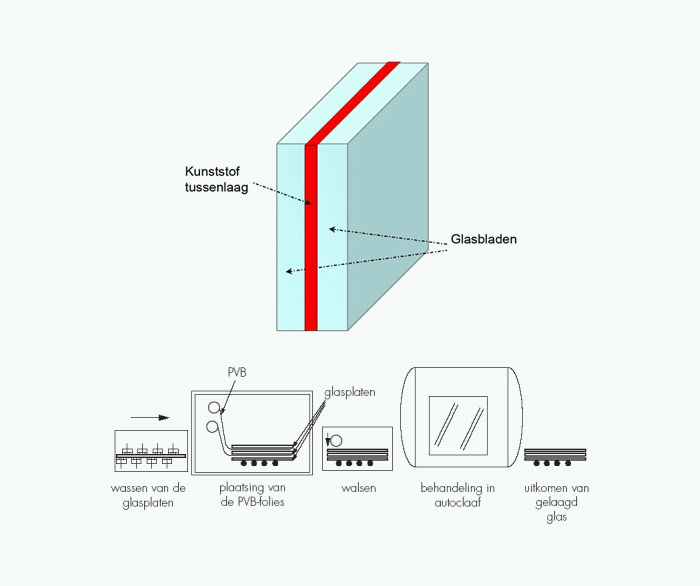
A laminated glass assembly consists of at least two panes of glass permanently bonded across their entire surface by one or more interlayers made from polymer films, resin or gel. Far more than simply holding the glass together, these interlayers play a critical role in determining the performance of the final glazing solution. The choice of interlayer is therefore a key consideration during the specification process.
The most common production method uses polymer interlayers such as PVB, ionoplast or EVA. The glass panes and interlayers are assembled and passed through rollers to remove trapped air. The assembly is then processed in an autoclave, where controlled heat and pressure create a permanent bond between the glass and interlayer. This process results in a highly durable laminate with excellent optical quality and long-term performance.
For certain specialised applications, a cast resin process is used. A spacer is positioned around the perimeter of the glazing assembly, after which liquid resin is poured between the glass panes. The resin is then cured under UV light through a controlled polymerisation process, forming a transparent and robust interlayer. This manufacturing method is frequently used for bespoke security, decorative and fire-resistant glazing applications.
Dimensions and Tolerances
Precision is essential in modern glazing systems. To ensure proper installation, structural performance and visual quality, laminated glass is manufactured within strict dimensional tolerances. The permissible deviations from nominal dimensions are outlined below.
| Thickness | Thickness > 8 mm | |||
|---|---|---|---|---|
| Measurement Type | Width or Height (mm) | ≤ 8 mm | Thickness of each pane < 10 mm | Thickness of at least one pane ≥ 10 mm |
| Standard sizes | max. 6000 x 3210 | + 5,0 / - 3,0 | + 6,0 / - 4,0 | + 8,0 / - 6,0 |
| < 1100 | + 2,0 / - 2,0 | + 2,5 / - 2,0 | + 3,5 / - 2,5 | |
| < 1500 | + 3,0 / - 2,0 | + 3,5 / - 2,0 | + 4,5 / - 3,0 | |
| Fixed sizes | < 2000 | + 3,0 / - 2,0 | + 3,5 / - 3,0 | + 5,0 / - 3,5 |
| < 2500 | + 4,5 / - 2,5 | + 5,0 / - 3,0 | + 6,0 / - 4,0 | |
| > 2500 | + 5,0 / - 3,0 | + 5,5 / - 3,5 | + 6,5 / - 4,5 | |
In addition to dimensional tolerances, the alignment of the individual glass panes within the laminate is carefully controlled. The edge offset, designated as ‘d’, represents the maximum distance between the edges of the component panes.
| Width or Height (mm) | Maximum Edge Offset ‘d’ (mm) |
|---|---|
| ≤ 1000 | 2,0 |
| 1000 − 2000 | 3,0 |
| 1000 − 2000 | 4,0 |
| > 4000 | 6,0 |
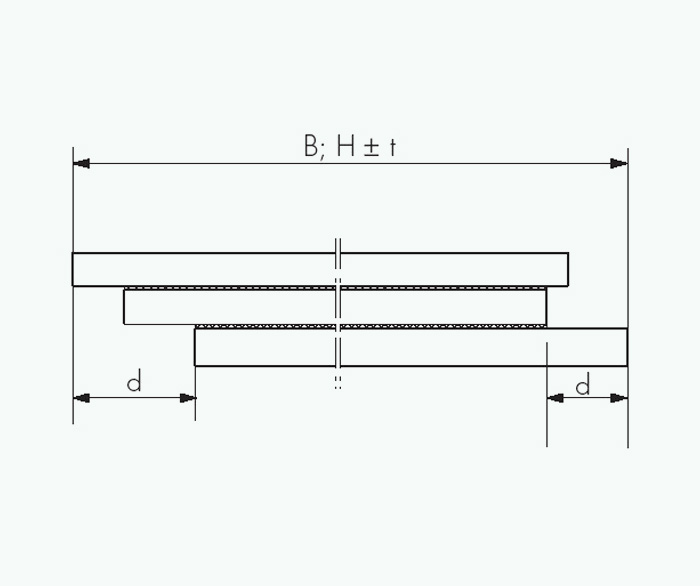
Maintaining proper edge alignment becomes increasingly important in thick, heavy laminated glass constructions, such as security and bullet-resistant glazing. Where support conditions are inadequate or uneven, a single pane may unintentionally carry a disproportionate share of the load. This can introduce local stress concentrations and increase the risk of glass failure. For laminated glass units weighing more than 100 kg or exceeding 34 mm in thickness, installation on a properly levelled and ground support surface is therefore strongly recommended.
For laminated glass manufactured with polymer interayers, the overall thickness tolerance is determined by the cumulative tolerances of the individual glass components. Interlayers with a thickness ‘e*’ below 2 mm are not considered in the calculation. Where the interlayer exceeds 2 mm, an additional tolerance of ±0.2 mm should be taken into account.
For cast laminated glass, the overall thickness is determined by combining the tolerances of both the glass panes and the resin interlayer.
| Interlayer Thickness e* (mm) | Tolerance (mm) |
|---|---|
| e* < 1 | ± 0,4 |
| 1 = e* < 2 | ± 0,5 |
| 2 = e* < 3 | ± 0,6 |
| 3 = e* | ± 0,7 |
Where a plastic sheet, such as polycarbonate, forms part of the laminate, the applicable thickness tolerances are generally aligned with those of float glass of equivalent thickness. Exceptions may apply where the material is covered by a valid European Technical Assessment (ETA) specifying alternative performance criteria or dimensional tolerances. For fire-resistant laminated glass and multi-interlayer constructions, tolerances are governed by NBN EN ISO 12543-5 [16].