
Technical Specifications Toughened Glass

Visual Considerations

Quench Marks

In its standard state, glass is an amorphous and therefore isotropic material, meaning it possesses identical optical and mechanical properties in all directions. During the thermal treatment process of heat-strengthened and toughened glass, surface compression stresses are introduced into the glass, causing the material to become anisotropic.

As a result of natural light conditions and varying reflective properties across the glass surface, certain patterns or colour variations may become visible. These optical effects are caused by interference phenomena created during the toughening process. Such visual patterns are an inherent characteristic of thermally treated glass and should not be regarded as a defect.

Bow and Optical Distortion

Due to the nature of the toughening process, thermally toughened glass is generally less flat than annealed glass. This may result in certain optical distortions.

To assess these distortions, a distinction is made between a local bow and overall bow. The correct measurement method for the bow is defined in the standard NBN EN 12150.

Overall flatness is measured along the edges and diagonals of the glass pane. The maximum bow (the greatest distance between the measuring straightedge or tensioned string and the glass surface) is expressed in millimetres. The maxium permitted bow is 3.0 mm/m for uncoated float glass and 4.0 mm/m for other glass types. For enamelled glass where the enamel coating does not fully cover the surface, consultation with the manufacturer is recommended.

Holes in Toughened Glass

Glass panels with drilled holes can be toughened, provided certain technical requirements are respected in order to minimise the risk of breakage during the toughening process.

Hole Diameter

The diameter of each hole must be at least equal to the glass thickness.

Hole Positioning

The permitted distance between the edge of a hole and the edge of the glass, between the edge of a hole and the corner of the glass and between two holes depends on:

  • The glass thickness ‘e’ (mm)
  • The glass dimensions B and H (mm)
  • The hole diameter ø (mm)
  • The shape of the glass
  • The number of holes

The guidelines below apply to glass panes with a maximum of four holes.

  • The distance ‘a’ between the edge of a hole and the edge of the glass must be at least twice the glass thickness: a ≥ 2e.
  • The distance ‘b’ between two holes must be at least twice the glass thickness: b ≥ 2e.
  • The distance ‘c’ between the edge of a hole and the corner of the glass must be at least six times the glass thickness: c ≥ 6e.
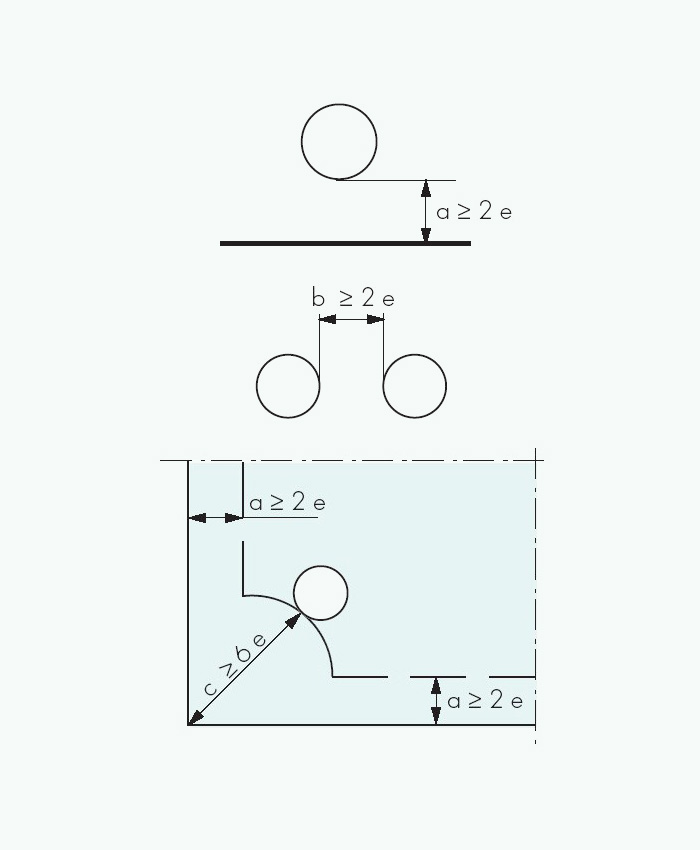
Drill holes toughened glass

Interested or have questions?

Our experts are happy to assist you with technical guidance, specifications and project support.